As we motored south along the Chicago Lakeshore, we encountered several Tartan-10 boats. The Tartan-10 is the largest one-design fleet in the Great Lakes, and as such they have their own 37 boat section in the race to Mackinac. The Tartan-10 boats have a slightly slower rating than the boats in our section (Section 7). Knowing that the Tartan-10’s start the race exactly 10 minutes before we do, we followed them to Navy Pier and eased ourselves into a space between some of them for the parade past the East end of the Pier.
When we were close enough to see people standing on the Pier, I called my parents to let them know to start looking for us and where to look. It was difficult to see individuals in the crowd through the fog and misty rain, but I hoped that the boat was large enough and distinct enough for them to identify. We passed once, headed south, at quite a distance. Then we lined up to head North right alongside the east end of the pier. The captains of each of the boats in the race provided the Chicago Yacht Club with a paragraph of information about their boat and crew that could be used to talk about the boats as they passed by during the parade. As we approached the pier, I could hear the announcer commenting on how he recognized certain boats and trying to read the names off the hulls of the boats he didn’t recognize. Clearly he wasn’t making use of the provided information. A few days after the race I learned that the printouts of the boat information had been destroyed in the rain, and that the announcer was doing what he could with information from the spectators near him, and what he already knew about the various boats.
As I could hear the announcer talking about the boat in front of us, I noticed my mother standing near the announcer on the pier pointing at our boat and talking to the announcer. In the background over the public address system I thought I could hear her voice excitedly asking him to talk about “Cyclone”. He made a comment about how she seemed more excited than anyone else there, and asked her if she’d like to introduce the boat. She agreed and took the microphone.
Everyone on Cyclone seemed entertained by the fact that we had our own personal announcer and that she sounded so excited as she announced our sail number “51804” and explained that this was Cyclone’s first time competing in the Race to Mackinac. My family snapped off a few pictures and a short video, as we all waved to the crowd. We turned east and received an acknowledgement from the committee boat as we made our way out of the breakwater and joined the growing numbers of boats in the starting area.
In the low visibility it took us a short while to find the markers that identify the start line, but we had it all figured out, had our watches synchronized with the race committee starting sequence, had our mainsail raised, and our engine turned off before the 10 minute warning for the Tartan-10 section. Once the Tartan-10 section crossed the start line, the starting area became far less crowded and we found plenty of room to get lined up for our start. We were surprised to hear over the radio that there were less than 5 Tartan-10 boats recalled for crossing the line early. We heard the race committee announce to each of the early boats that they were clear as they returned to the start-line.
When the 5 minute warning sounded for our section we raised our jib. Two minutes before the start we headed parallel to the start-line and checked the time as we passed beyond the floating mark that indicates the end of the line. The “P” semaphore flag indicating “prepare for the start of the race” is dropped from the starting boat flag pole along with the sounding of a horn at exactly one minute before the start of the race, and we used this signal as our indication that it was time to turn the boat around 180 degrees and head back toward the start-line. With 15 seconds until the start for our section, we sailed past the near marker of the start-line and continued parallel to the line for the next 15 seconds. I was surprised that we had such a wide open area at this time. I’m accustomed to a much more crowded start-line with our weekend club races. I suspect that we were fortunate to have a larger than necessary line for our 25 boat section to provide enough room for some of the larger sections that would be starting before and after us. I also suspect that the terribly light winds made it difficult for many of the boats to time their approach to the line. As it was, there were no boats over the line early in our section and moments after the starting gun, we were headed downwind across the line.
Once we were clearly across the line and certain that we weren’t going to run into any issues where we might need to avoid another boat, it was time to launch the spinnaker. We extend the bowsprit, reel in the tack-line to bring the tack of the sail out to the end of the bowsprit, and quickly use the halyard to raise the head of the sail up the mast. I run around to the upwind side of the boat as Holly hands me the Spinnaker sheet. Then I quickly look up at the sail to watch it take shape as it fills with air so I can trim it for the best possible speed given our current heading.
Only it doesn’t fill with air or take shape. It just dangles there like a flag on a windless day. I try pulling it in tight to stretch it as flat as possible in hopes that a light breeze will catch it. I shout to John to head further upwind in hopes that any breeze that might exist will catch it at a good angle. I try letting it out completely in case I’v got it pulled to tight to take shape. I beg for wind and I start pulling it in again. With less than 5 knots of wind and the boat moving at over 1 knot, the breeze just isn’t enough to work even this light-weight sail. After what was probably less than a minute, but felt like twenty minutes, the breeze picked up just enough to fill the sail and we worked our way down the course. Before we had worked our way north back up near Montrose harbor where we began our day, we had already passed several Tartan-10 boats (remember they started 10 minutes before us), and had others that we were catching up to. There were J/105 boats that started after us (they are rated as slightly faster) that were unable to catch up to us. This was a great start to the race, and what little wind we had was coming from the south like we had hoped.
We were aware that the weather report called for changing weather conditions before the race was over, but we were sure feeling good about our accomplishments at this point. The race continued like this as we headed north-east. After several uneventful hours of passing boats and watching the fog get thicker, and knowing that we had days of racing ahead of us I handed off the Spinnaker sheets to Nora and headed down below to get some sleep. My next shift would begin at 8:00pm.
Wednesday, July 30, 2008


Saturday, July 26, 2008
Pre-Mac Prep.
7/6/2008
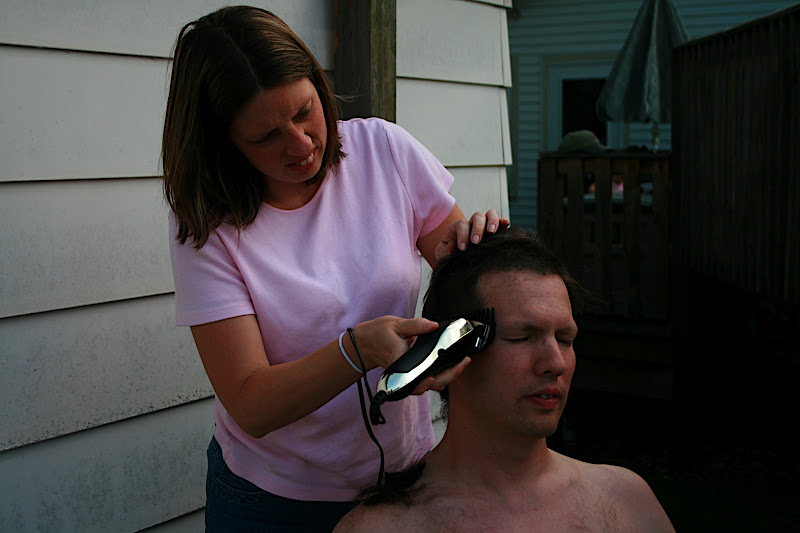
I had decided that my relatively long hair was going to be a hassle for the race to Mackinac. So I asked my sister Ginette if she would mind using the trimmer she has to buzz cut it for me. I wanted it to have time to grow out just a bit so I arranged for her to cut it about 2 weeks ahead of time.
7/17/2008
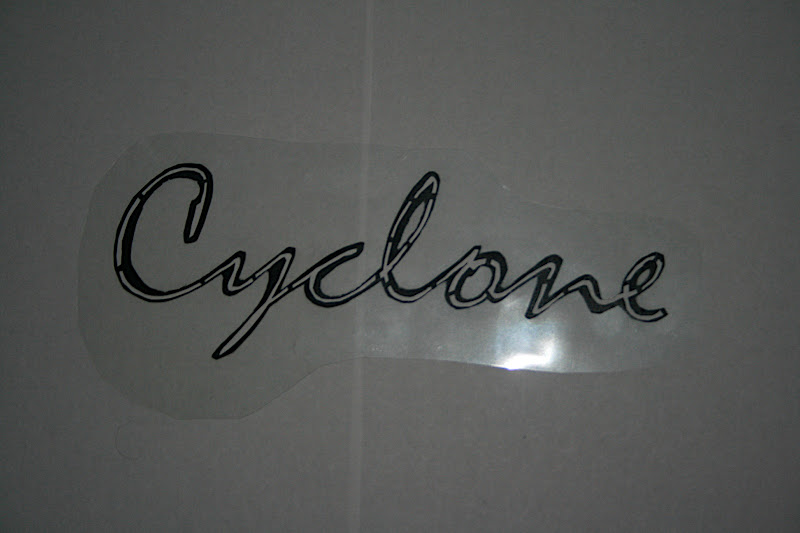
I had this “great” idea that since my hair is so short and buzzed in the back, I could get the team logo shaved into the hair on the back of my head. I talked to a hair stylist and she said to make a copy of the logo, enlarge it on a copier and then cut it out to be used as a stencil. So, Thursday night, I stayed up most of the night cutting stencils into plastic transparency sheets to be used to shave the boat logo into the hair on the back of my head.
7/18/2008
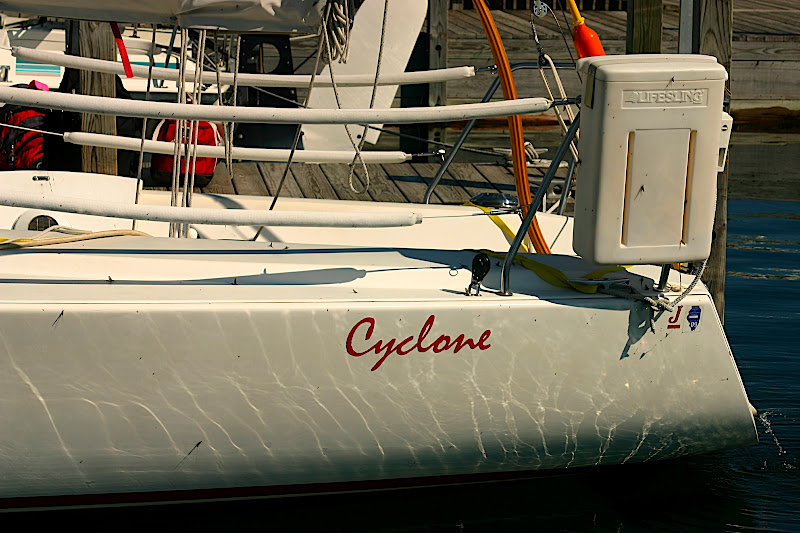
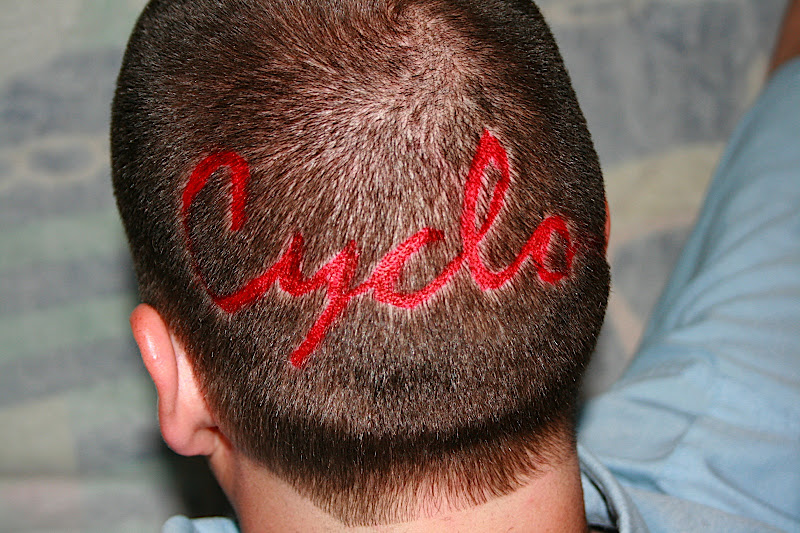
I stopped off after work with my stencils to get the boat logo shaved into the hair on the back of my head. The person who did the work didn’t realize that the connecting pieces of the stencil weren’t part of the logo and that they were just there to hold the letters together, so I had what really looked like a stencil on the back of my head. When I got home, Lisa cleaned up the logo so it would stand out better, and shaved the hair all the way down to the bare skin. Then she used a red Sharpie permanent marker to color the skin and hair to match the boat logo.
I went to sleep and when I woke up the next morning, I found the pillow case stained with red permanent marker.

I took a shower and discovered the “permanent” marker wasn’t so permanent on scalp skin and hair. I was left with a slight pink color on the skin, and no color in the hair at all.
I had decided that my relatively long hair was going to be a hassle for the race to Mackinac. So I asked my sister Ginette if she would mind using the trimmer she has to buzz cut it for me. I wanted it to have time to grow out just a bit so I arranged for her to cut it about 2 weeks ahead of time.
7/17/2008
I had this “great” idea that since my hair is so short and buzzed in the back, I could get the team logo shaved into the hair on the back of my head. I talked to a hair stylist and she said to make a copy of the logo, enlarge it on a copier and then cut it out to be used as a stencil. So, Thursday night, I stayed up most of the night cutting stencils into plastic transparency sheets to be used to shave the boat logo into the hair on the back of my head.
7/18/2008
I stopped off after work with my stencils to get the boat logo shaved into the hair on the back of my head. The person who did the work didn’t realize that the connecting pieces of the stencil weren’t part of the logo and that they were just there to hold the letters together, so I had what really looked like a stencil on the back of my head. When I got home, Lisa cleaned up the logo so it would stand out better, and shaved the hair all the way down to the bare skin. Then she used a red Sharpie permanent marker to color the skin and hair to match the boat logo.
I went to sleep and when I woke up the next morning, I found the pillow case stained with red permanent marker.

I took a shower and discovered the “permanent” marker wasn’t so permanent on scalp skin and hair. I was left with a slight pink color on the skin, and no color in the hair at all.
7/19/2008
I overslept and got ready to go as quickly as possible. The schedule called for everyone to meet at the dock by the boat at 8:00AM. In order to make it to the boat by then, those who were leaving a car at Capt. John’s house needed to meet at his house by 7:30. Since Lisa needed to be at work by 8:00am, there wasn’t time for her to drop me off at the boat or at John’s house, so I made arrangements to ride to John’s house with another crew member, Holly, who lives in Orland Park. To make it to John’s house on time we needed to leave Orland Park by 6:30am. Lisa said she could drop me off in Orland before she got ready for work, so I needed to leave home by 5:45am. I was supposed to wake up at 5:00am. This did not happen.
After waking at 5:28am, I quickly took a shower and finished up some last minute packing. There were a pair of sailing gloves I really wanted to bring with me, that I had to search the house for before they finally turned up. Then Lisa offered to quickly touch up the logo in my hair with the red “permanent” marker again so it would at least stand out until the race started. I’d need to wash it out before my first sleep shift so I wouldn’t stain my sleeping bag or anything on the boat. It didn’t look as good as it had the night before, but it was better than nothing. Everytime I thought I was ready to walk out the door I thought of something else that I needed/wanted. As we backed down the driveway, I realized that I had never printed out the directions to Holly’s house and I didn’t know where she lived. I ran back into the house to look up her address on the team website and write it down along with her phone number. By the time we were actually on the road, it was a few minutes after 6:00am.
I called Holly to let her know that we were running later than expected, and that I wouldn’t be there early like I had originally intended, but that I should still make it there by 6:30. I asked for directions to her house and as she explained, I realized that with all the stoplights on LaGrange Ave by the mall, we’d need to get pretty lucky and catch all the green lights to get to her house by 6:30.
After catching the eighth stoplight in a row, I called Holly again to explain that we were going to be a little late, and to ask if there is somewhere along the way that we could meet up to reduce the delay in getting to John’s house on time. Holy suggested a gas station on LaGrange avenue a bit north of the mall, and we agreed to meet up with her there.
When we got to the gas station, Holly wasn’t there yet, and I noticed it was a convenience store as well. I took a look inside and found they had red permanent markers. Since we had a bit of time while we waited for Holly to arrive, and since Lisa was disappointed with how the logo looked this morning when she quickly traced over it with the marker we had at home, and since I had already committed to washing it out after the start of the race, I purchased the marker and brought it out for Lisa to touch up the logo and make it look better.
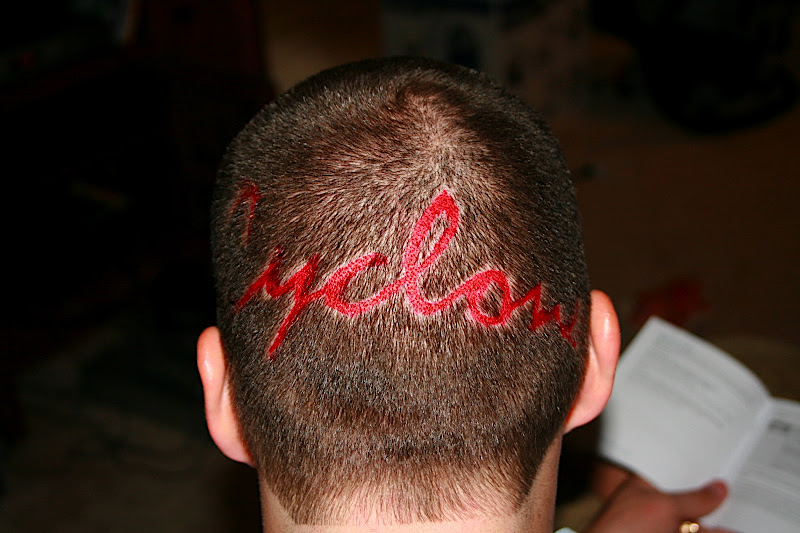
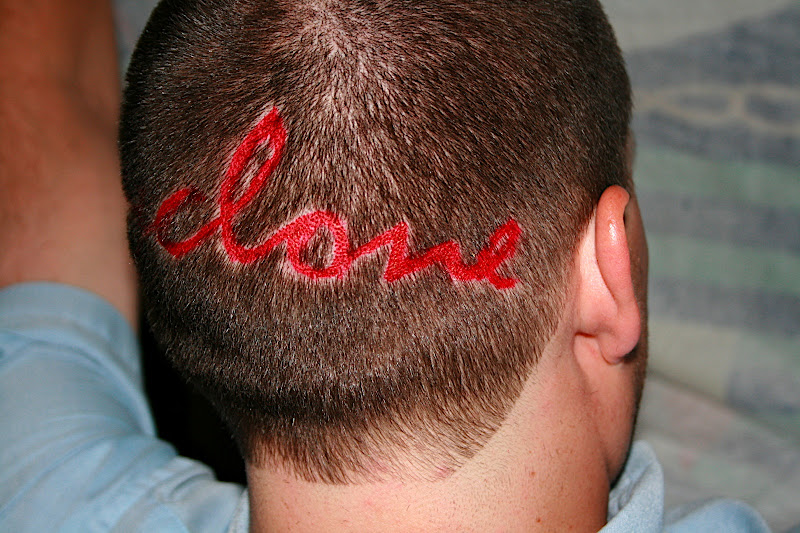
Holly showed up shortly after, and the rest of the morning was relatively uneventful. We got to John’s house on time, where we met up with Scott, and John. Then we headed down to the pier where we met up with Wally and Nora. Wally’s family came with him to see us off, as did John’s girlfriend. Nancy, a member of the usual Cyclone crew, was originally slated to be a member of the crew for the race to Mackinac, however due to an injury she had to withdraw a few weeks before the race, and Scott took her place. Capt. John Madey has a friend John Frendreiss who is a hobby photographer and maintains the Cyclone website for him. Nancy and John F. agreed to be our “shore crew” to carry equipment not needed for the race, but that would be needed after the race up to Mackinac for us. They both showed up at the pier to see us off. John F. got a few good pictures, and then everyone who came to see us off headed to Navy Pier to see us in the boat parade. We fired up the diesel and cast off, in the dreary gray drizzle and the barely there breeze to head out to the pre-race boat parade at Navy Pier.
I overslept and got ready to go as quickly as possible. The schedule called for everyone to meet at the dock by the boat at 8:00AM. In order to make it to the boat by then, those who were leaving a car at Capt. John’s house needed to meet at his house by 7:30. Since Lisa needed to be at work by 8:00am, there wasn’t time for her to drop me off at the boat or at John’s house, so I made arrangements to ride to John’s house with another crew member, Holly, who lives in Orland Park. To make it to John’s house on time we needed to leave Orland Park by 6:30am. Lisa said she could drop me off in Orland before she got ready for work, so I needed to leave home by 5:45am. I was supposed to wake up at 5:00am. This did not happen.
After waking at 5:28am, I quickly took a shower and finished up some last minute packing. There were a pair of sailing gloves I really wanted to bring with me, that I had to search the house for before they finally turned up. Then Lisa offered to quickly touch up the logo in my hair with the red “permanent” marker again so it would at least stand out until the race started. I’d need to wash it out before my first sleep shift so I wouldn’t stain my sleeping bag or anything on the boat. It didn’t look as good as it had the night before, but it was better than nothing. Everytime I thought I was ready to walk out the door I thought of something else that I needed/wanted. As we backed down the driveway, I realized that I had never printed out the directions to Holly’s house and I didn’t know where she lived. I ran back into the house to look up her address on the team website and write it down along with her phone number. By the time we were actually on the road, it was a few minutes after 6:00am.
I called Holly to let her know that we were running later than expected, and that I wouldn’t be there early like I had originally intended, but that I should still make it there by 6:30. I asked for directions to her house and as she explained, I realized that with all the stoplights on LaGrange Ave by the mall, we’d need to get pretty lucky and catch all the green lights to get to her house by 6:30.
After catching the eighth stoplight in a row, I called Holly again to explain that we were going to be a little late, and to ask if there is somewhere along the way that we could meet up to reduce the delay in getting to John’s house on time. Holy suggested a gas station on LaGrange avenue a bit north of the mall, and we agreed to meet up with her there.
When we got to the gas station, Holly wasn’t there yet, and I noticed it was a convenience store as well. I took a look inside and found they had red permanent markers. Since we had a bit of time while we waited for Holly to arrive, and since Lisa was disappointed with how the logo looked this morning when she quickly traced over it with the marker we had at home, and since I had already committed to washing it out after the start of the race, I purchased the marker and brought it out for Lisa to touch up the logo and make it look better.
Holly showed up shortly after, and the rest of the morning was relatively uneventful. We got to John’s house on time, where we met up with Scott, and John. Then we headed down to the pier where we met up with Wally and Nora. Wally’s family came with him to see us off, as did John’s girlfriend. Nancy, a member of the usual Cyclone crew, was originally slated to be a member of the crew for the race to Mackinac, however due to an injury she had to withdraw a few weeks before the race, and Scott took her place. Capt. John Madey has a friend John Frendreiss who is a hobby photographer and maintains the Cyclone website for him. Nancy and John F. agreed to be our “shore crew” to carry equipment not needed for the race, but that would be needed after the race up to Mackinac for us. They both showed up at the pier to see us off. John F. got a few good pictures, and then everyone who came to see us off headed to Navy Pier to see us in the boat parade. We fired up the diesel and cast off, in the dreary gray drizzle and the barely there breeze to head out to the pre-race boat parade at Navy Pier.
Thursday, July 17, 2008
In case I don't have your email
The following email went out to everyone in my email address book. In case I don't have your email address, I'm posting a copy of the email message here:
As many of you know I am racing in the 2008 Chicago to Mackinac sailboat race. This year's race is the 100th running and a record 440 boats from around the world will be participating. The race starts this Saturday July 19th, A boat parade will be going past the east end of Navy Pier starting at 10AM. Best place to watch is from the east end of the second tier of the pier. There will be TV crews and an announcer talking about the boats. Look for "Cyclone" # 51804. We will be starting the race at 12:10PM about 1 mile east of the Chicago lighthouse. This year all of the boats will be equipped with satellite tracking transponders. You can watch my teams progress at:
http://charthorizon.com/races/2008_chicago_mackinac/htdocs/
Pictures, race reports and video can be found at:
http://www.chicagomackinac.com/2008/
For additional information check out the various links at the Chicago Yacht Club's official Race to Mackinac website:
http://chicagoyachtclub.org/racetomackinac/
If it is an average race we should finish sometime Monday afternoon/ early evening. At 30 ft we are one of the smallest boats in the race (smallest is 28 ft) and we are the smallest boat in our section which is "Section 7". We will be in direct competition with boats up to 50 ft and with only six people on board we have one of the smallest crews. Feel free cheer us on by keeping your browser on us.
Again the boat name is "Cyclone" and the sail number is 51804.
- Danny
FAQ:
Q. If you guys are one of the smallest boats how can you guys win?
A. Boats are handicapped by a mathematical rating systems which predict how fast they should be capable of sailing under a variety of conditions. Applying these ratings to each boat's elapsed time on the race course determines which boat sailed the best relative to their rating, and therefore determines the winner. This allows the entire fleet to compete against each other. We have just as much chance of winning as the 96 ft "Genuine Risk". They might finish before us but after the handicap is applied we can correct on the bigger boats. Although we are one of the smallest we are somewhere in the middle for speed. Cyclone is a bit of a hot rod for its size.
Q. Do you race at night?
A. Yes the crew is divided into shifts, half of the crew is down below sleeping while the other half is sailing. If the on deck crew needs help they call "all hands on deck" for help.
Q. What about food and water?
A. We bring enough to last till Tuesday.
Q. What if someone has to go to the bathroom?
A. Cyclone has a head, know as a toilet to landlubbers.
Q. What if there is bad weather?
A. We race right through it and we have lots of required safety equipment in case something bad happens. The worst part is if there is no wind, the flies can get very bad.
Q. Is there a shower?
A. No, if you finish 25 Mac races you are called an "Old Goat" you can guess why they have that name.
Q. How do you know how to get there?
A. We have a GPS (Global Positioning System) that tells us where we are, and we carry printed charts as a backup.
Q. Does the Coast Guard know about this?
A. Yes and they send the 245 ft ice breaker "USCG Mackinaw" and the 140 ft "USCG Mobile Bay" to shadow the fleet.
Q. What do the winners receive?
A. The Chicago to Mackinac race is an amateur event, so no prize money is awarded. The Section winners will receive a plaque, a flag, and bragging rights for the next year. The overall winners have their names engraved on the permanent trophies that are displayed at Chicago Yacht Club.
As many of you know I am racing in the 2008 Chicago to Mackinac sailboat race. This year's race is the 100th running and a record 440 boats from around the world will be participating. The race starts this Saturday July 19th, A boat parade will be going past the east end of Navy Pier starting at 10AM. Best place to watch is from the east end of the second tier of the pier. There will be TV crews and an announcer talking about the boats. Look for "Cyclone" # 51804. We will be starting the race at 12:10PM about 1 mile east of the Chicago lighthouse. This year all of the boats will be equipped with satellite tracking transponders. You can watch my teams progress at:
http://charthorizon.com/races/2008_chicago_mackinac/htdocs/
Pictures, race reports and video can be found at:
http://www.chicagomackinac.com/2008/
For additional information check out the various links at the Chicago Yacht Club's official Race to Mackinac website:
http://chicagoyachtclub.org/racetomackinac/
If it is an average race we should finish sometime Monday afternoon/ early evening. At 30 ft we are one of the smallest boats in the race (smallest is 28 ft) and we are the smallest boat in our section which is "Section 7". We will be in direct competition with boats up to 50 ft and with only six people on board we have one of the smallest crews. Feel free cheer us on by keeping your browser on us.
Again the boat name is "Cyclone" and the sail number is 51804.
- Danny
FAQ:
Q. If you guys are one of the smallest boats how can you guys win?
A. Boats are handicapped by a mathematical rating systems which predict how fast they should be capable of sailing under a variety of conditions. Applying these ratings to each boat's elapsed time on the race course determines which boat sailed the best relative to their rating, and therefore determines the winner. This allows the entire fleet to compete against each other. We have just as much chance of winning as the 96 ft "Genuine Risk". They might finish before us but after the handicap is applied we can correct on the bigger boats. Although we are one of the smallest we are somewhere in the middle for speed. Cyclone is a bit of a hot rod for its size.
Q. Do you race at night?
A. Yes the crew is divided into shifts, half of the crew is down below sleeping while the other half is sailing. If the on deck crew needs help they call "all hands on deck" for help.
Q. What about food and water?
A. We bring enough to last till Tuesday.
Q. What if someone has to go to the bathroom?
A. Cyclone has a head, know as a toilet to landlubbers.
Q. What if there is bad weather?
A. We race right through it and we have lots of required safety equipment in case something bad happens. The worst part is if there is no wind, the flies can get very bad.
Q. Is there a shower?
A. No, if you finish 25 Mac races you are called an "Old Goat" you can guess why they have that name.
Q. How do you know how to get there?
A. We have a GPS (Global Positioning System) that tells us where we are, and we carry printed charts as a backup.
Q. Does the Coast Guard know about this?
A. Yes and they send the 245 ft ice breaker "USCG Mackinaw" and the 140 ft "USCG Mobile Bay" to shadow the fleet.
Q. What do the winners receive?
A. The Chicago to Mackinac race is an amateur event, so no prize money is awarded. The Section winners will receive a plaque, a flag, and bragging rights for the next year. The overall winners have their names engraved on the permanent trophies that are displayed at Chicago Yacht Club.
MasterCard
- Life Jacket - $
- Harness -$
- 6 Foot Tether - $
- Emergency Strobe Light - $
- 2 Pair Sailing Gloves - $
- 2 Pair Sunglasses - $
- 1 8-oz. Bottle Sunblock - $
- Team Shirt - $
- Team Cap - (free)
- Pocket Knife - $
- Foul Weather Gear - $
- Sleeping Bag - $
- Entry Fee - $
- Provisions - $
- Lodging on Island for 2 nights - $
Priceless.
Wednesday, July 16, 2008
Where's Waldo (Danny)
For the first time in the 107 year history of the race, every boat in the Chicago Yacht Club Race to Mackinac will be supplied with a GPS tracking system. This means that for the few who are interested, this can be a spectator sport. This link should take you to a website that will allow you to identify the current location of all the boats participating in the race. To find out where in Lake Michigan I am at any time during the race, you'll need to choose our boat, Cyclone, from the selection list. I've never used this tracking system before, so I can't offer much advice on how to use it. I've been informed that right now you can look at the "2008 Newport Bermuda Race" under the "View Past Races" to get an idea of how the website is supposed to work for the Mac race once the Mac race begins.
Information you may (or may not) find useful when attempting to determine how well we are doing, and where we are located:
Our boat name - Cyclone
Our sail number - 51804
Our section - 7
Our Division - Chicago-Mackinac Trophy Division
Our start time - 12:10pm
Our class flag - Pink
Our rivalries - Dos Aguilas, Most Wanted, Pegasus, Vayu
Boats with a similar ORR rating - Drumbeat, Sociable
Slowest boats in our section (they better be behind us, because their position will improve on ours after the race due to the ORR rating adjustments) - Celerity, Foray
Fastest boats in our section (they need to be way ahead of us to beat us, because our position will improve on them after the race due to the ORR rating adjustments) - Madcap, Windrunner, Challenge
Information you may (or may not) find useful when attempting to determine how well we are doing, and where we are located:
Our boat name - Cyclone
Our sail number - 51804
Our section - 7
Our Division - Chicago-Mackinac Trophy Division
Our start time - 12:10pm
Our class flag - Pink
Our rivalries - Dos Aguilas, Most Wanted, Pegasus, Vayu
Boats with a similar ORR rating - Drumbeat, Sociable
Slowest boats in our section (they better be behind us, because their position will improve on ours after the race due to the ORR rating adjustments) - Celerity, Foray
Fastest boats in our section (they need to be way ahead of us to beat us, because our position will improve on them after the race due to the ORR rating adjustments) - Madcap, Windrunner, Challenge
On The Tube
Tomorrow, Thursday July 17, WGN Channel 9 will broadcast a special segment on the Island Goats Sailing Society between 9:00 p.m. and 10:00 p.m.
In honor of the 100th running of the Mac, WTTW will be re-broadcasting a 45-minute documentary made in 2000 about the Race to Mackinac. The program will air at 8pm tomorrow, Thursday July 17th, on WTTW Channel 11.
Tonight, Wednesday July 16th, WTTW’s “Chicago Tonight” program will talk about the 100th running of the Mac and promoting the Thursday night documentary broadcast. That will be between 7pm and 8pm.
In honor of the 100th running of the Mac, WTTW will be re-broadcasting a 45-minute documentary made in 2000 about the Race to Mackinac. The program will air at 8pm tomorrow, Thursday July 17th, on WTTW Channel 11.
Tonight, Wednesday July 16th, WTTW’s “Chicago Tonight” program will talk about the 100th running of the Mac and promoting the Thursday night documentary broadcast. That will be between 7pm and 8pm.
Tuesday, July 15, 2008
Weather of Course
In my previous post, I mention that the course for a sailboat race is frequently chosen to reduce any advantage a particular boat design might have. Most of the races Cyclone participates in are set up this way. Some boats have an advantage upwind, others downwind, and still others when sailing sideways to the wind. To keep things reasonably fair, one common course used for our weekly races begins with a destination that is nearly straight upwind three fourths of a mile. From this destination the course turns left and heads sideways to the wind (and just slightly down wind) with the wind blowing on the starboard (right) side of the boat for nearly six tenths of a mile. The course then turns left again heading straight downwind for one mile. Turning left yet again, the course proceeds sideways to the wind (and just slightly downwind) again, this time with the wind blowing on the port (left) side of the boat for nearly six tenths of a mile again. Turning left again, the course is once again straight upwind and heading towards the start-line (which is also used as the finish-line). To extend the distance of the race, this course is typically sailed "twice around". If you are familiar with geometric shapes this course is an isosceles trapezoid. The race begins and finishes at the midpoint of the long base of the trapezoid, and the wind is blowing straight down this line.
This course forces all the racers to sail upwind (also known as "close hauled", "on a beat" or "on a tack"), downwind (also known as "running", or "on a run"), and sideways to the wind (also known as "reaching" or "on a reach").
Because the Chicago to Mackinac race is a one way race, and the start-line and finish-line really can't be moved, the weather can have a significant effect on the results of the race. The ORR handicapping system used for this race attempts to compensate for variations in boat design, and without sufficient skill and talent a racing crew is unlikely to win even with the best possible conditions for their boat. However, if two boats of differing design are raced equally well, the one whose design is most adversely affected by the weather will lose.
This means that under certain weather conditions if we sail our boat perfectly without making a single mistake, while we will finish ahead of those with less skill and talent, competitors who sail their boats as well as we do will beat us. Under other weather conditions, if we sail our boat perfectly, we will be unbeatable since even if they sail perfectly as well the competing boat will not be able to overcome the effects of the weather. Of course, if we make mistakes and sail "less than optimally" we will finish a bit later than we could have and will create an opportunity for the skill and talent of a competitor to compensate for the limitations the weather on their boat.
Length of the boat has a large effect on the ability of the boat to sail upwind. Typically, the longer the boat, the better it can sail upwind. At 30 feet Cyclone is the shortest hull length in our section. As such, any wind blowing from anywhere in a north-like direction (northwest, north, northeast, just slightly north of due east, etc) will place a huge limitation on us. We will need to sail significantly better than all 22 other competitors in our section just to compensate for the limitations of the boat length. On the other hand, wind coming from the southwest or from slightly south of due west will be optimal for us. With a wind coming from a southwest (or similar) direction, our competitors will need to overcome limitations of the designs of their boats, and if we can sail just slightly better than they do we will almost certainly win against the boats in our section.
In a race that will take multiple days to complete, the weather is likely to change multiple times throughout the race. Sometimes we will benefit, sometimes our competitors will. Part of our challenge will be to look at weather predictions before and during the race and determine where the weather is likely to help us the most (or hurt us the least), and sail the boat to try to be in the appropriate location when the weather is right.
For now all we can do is wait until the weather forecasts become more reliable and hope for southwest winds.
This course forces all the racers to sail upwind (also known as "close hauled", "on a beat" or "on a tack"), downwind (also known as "running", or "on a run"), and sideways to the wind (also known as "reaching" or "on a reach").
Because the Chicago to Mackinac race is a one way race, and the start-line and finish-line really can't be moved, the weather can have a significant effect on the results of the race. The ORR handicapping system used for this race attempts to compensate for variations in boat design, and without sufficient skill and talent a racing crew is unlikely to win even with the best possible conditions for their boat. However, if two boats of differing design are raced equally well, the one whose design is most adversely affected by the weather will lose.
This means that under certain weather conditions if we sail our boat perfectly without making a single mistake, while we will finish ahead of those with less skill and talent, competitors who sail their boats as well as we do will beat us. Under other weather conditions, if we sail our boat perfectly, we will be unbeatable since even if they sail perfectly as well the competing boat will not be able to overcome the effects of the weather. Of course, if we make mistakes and sail "less than optimally" we will finish a bit later than we could have and will create an opportunity for the skill and talent of a competitor to compensate for the limitations the weather on their boat.
Length of the boat has a large effect on the ability of the boat to sail upwind. Typically, the longer the boat, the better it can sail upwind. At 30 feet Cyclone is the shortest hull length in our section. As such, any wind blowing from anywhere in a north-like direction (northwest, north, northeast, just slightly north of due east, etc) will place a huge limitation on us. We will need to sail significantly better than all 22 other competitors in our section just to compensate for the limitations of the boat length. On the other hand, wind coming from the southwest or from slightly south of due west will be optimal for us. With a wind coming from a southwest (or similar) direction, our competitors will need to overcome limitations of the designs of their boats, and if we can sail just slightly better than they do we will almost certainly win against the boats in our section.
In a race that will take multiple days to complete, the weather is likely to change multiple times throughout the race. Sometimes we will benefit, sometimes our competitors will. Part of our challenge will be to look at weather predictions before and during the race and determine where the weather is likely to help us the most (or hurt us the least), and sail the boat to try to be in the appropriate location when the weather is right.
For now all we can do is wait until the weather forecasts become more reliable and hope for southwest winds.
Subscribe to:
Posts (Atom)
